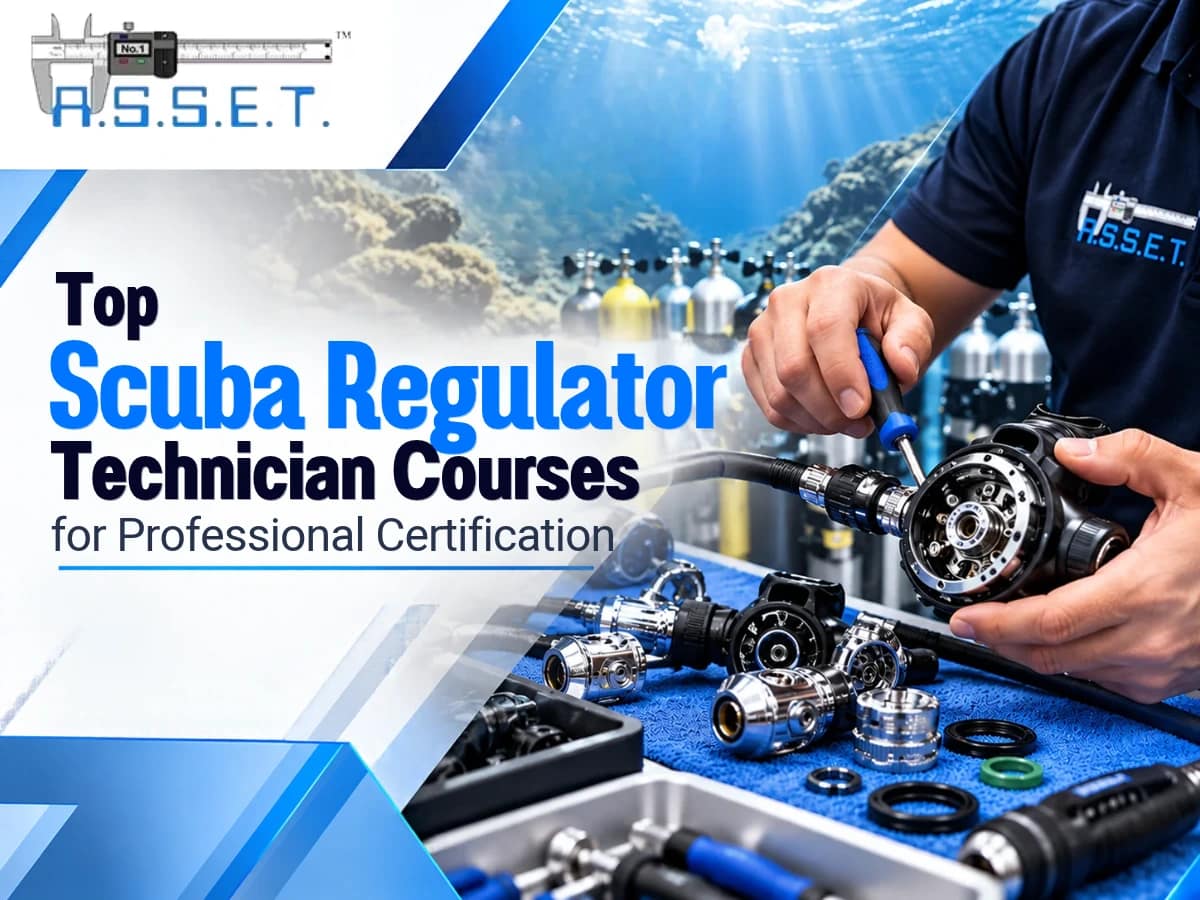
Top Scuba Regulator Technician Courses for Professional Certification
A busy Friday at a dive center. A rental regulator starts free-flowing on the boat deck, and the one person who “knows a bit about regulators” is on holiday. This is a common problem, but it can be solved easily. The owner can ship every regulator away for weeks or train someone. But the question arises: to train in which course?
This is where time and money get wasted. A weekend gear-care class, a manufacturer seminar, and a ten-day workshop course all get called scuba regulator training. They don’t prepare you for the same work.
This guide compares the main scuba regulator technician courses, so you can match the course type, certificate, and hands-on time to the job you want.
Which Scuba Regulator Technician Course Is Right for You?
Start with the work and purpose, not the course name. These four routes sit on very different steps of the ladder.
| Training route | Best suited to | Main purpose |
| PADI Equipment Specialist | Recreational divers | Basic care and minor repairs of your own kit |
| SSI Equipment Techniques | Recreational divers | Choosing, storing and basic preventive maintenance |
| Professional dive technician course | Aspiring technicians and dive professionals | Wider servicing, repair, workshop and safety skills |
| Manufacturer-specific regulator course | Technicians working on one brand | Servicing and testing that maker’s equipment |
They aren’t interchangeable. What you may service and for whom depends on your qualification, the manufacturer, and your employer or local rules. Always check before you book.
Types of Scuba Regulator Training and Certification
1. PADI Equipment Specialist: What Does It Teach?
PADI describes it as a way to handle basic repairs and adjustments, such as a missing O-ring, a torn wetsuit, or a broken fin strap. You also learn how your gear works. You need to be at least 10 and hold a PADI (Junior) Scuba Diver or higher. PADI doesn’t describe it as scuba regulator servicing certification, so don’t treat it as one.
2. SSI Equipment Techniques: Who Should Take It?
SSI frames this course around choosing and storing your kit, understanding its parts, and practicing basic preventive maintenance. It suggests 3–6 hours and four academic sessions. The minimum age is 10, and you need Open Water Diver scuba diving certification or must take it alongside that course.
Ask the center what the offering price covers, because SSI says materials, tuition, and certification may be charged separately.
3. Professional Dive Technician Training
This is a different level of commitment. The Dive Industry Technicians Course at dive-technician.com runs 10 days: four academic days (online or classroom) and six workshop days. Its regulator module covers disassembly, assembly, maintenance, and troubleshooting.
The rest of the syllabus adds compressors, workshop setup, record-keeping, and cylinder testing. It ends with a practical and a written exam. For the full syllabus, read our guide to regulator technician training.
4. Manufacturer-Specific Regulator Service Courses
Poseidon Pro Academy shows how these work. Its regulator service course is one day (8 hours) and covers Cyklon, Jetstream, and Xstream regulators plus the Atmosphere full-face mask. You must be 18 or older and own, run, or work for a registered service center with the right tools and test equipment.
After that, you can service your own Poseidon gear. Servicing for other people requires affiliation with an Authorized Poseidon Service Center. Other makers set their own rules, and even Poseidon’s US training pages list different prices and entry rules. Read the rules for your region.
What Should a Professional Scuba Regulator Course Include?
A course title tells you little. The syllabus and the workshop tell you more.
1. Regulator Design, Components, and Fault Diagnosis
A good course explains why a regulator behaves the way it does, not just which part to swap. You should learn how the first and second stages differ and how to trace a symptom such as free-flow or hard breathing back to its cause.
2. Supervised Servicing, Testing, and Documentation
Reading about a regulator isn’t the same as servicing one. Look for supervised workshop time, the correct tools, manufacturer procedures, and written test results. Service records matter too, because they show what was done and what was checked.
3. Workshop Safety and Equipment Compatibility
Regulators supply breathing gas, so mistakes carry real risk. A course should teach safe working habits and parts compatibility. It should also teach when to pass a job to an authorized provider. A good instructor will tell you what you shouldn’t touch.
How to Compare Scuba Regulator Technician Courses
All details below come from each provider’s own page
| Course and provider | Format and location | Time and entry rules | Brands, assessment, and certificate | Published fee |
| PADI Equipment Specialist | Through PADI dive centres | Duration not stated; age 10+, PADI (Junior) Scuba Diver or higher | General gear; assessment not stated | Not on page |
| SSI Equipment Techniques | Through SSI centres | 3–6 hours suggested; age 10+, Open Water Diver | Personal kit; assessment not stated | Set by the centre |
| Dive Industry Technicians Course | Protaras, Cyprus; theory online or classroom | 10 days (4 academic, 6 workshop); diving prerequisite not stated | Brand list not published; practical and written exams; ASSET, SITA and IDEST certification per the page | €1,700 |
| Poseidon regulator service | Pro Academy offices or online with a shipped kit | 1 day; 18+, linked to a service centre | Poseidon only; Poseidon GMT certificate; third-party servicing needs an authorised centre | 250 € |
| EIDS equipment repair (Alexandria) | On site in Egypt | Listed as 1 week; entry rules not published | Not published | Not published |
Questions to Ask Before Paying for a Course
- What exact certificate will I receive?
- How much supervised practical training is included?
- Which brands and models will I work on?
- Are tools and service documentation supplied?
- Is there a practical assessment?
- What are the total costs, including travel and extras?
- Is support available after the course?
- What more might my intended job require?
How to Choose Training for Your Career Goals
This matrix shows what each published page establishes.
| Task | PADI | SSI | DITC | Poseidon |
| Basic care, minor fixes | Covered | Partly | Not established | Not established |
| Servicing regulators as a trade | Not established | Not established | Covered | Covered (Poseidon only) |
| Workshop records | Not established | Not established | Covered | Partly |
| Cylinder inspection | Not established | Not established | Covered | Not established |
| Compressors and air quality | Not established | Not established | Covered | Not established |
| Servicing others’ gear for pay | Not established | Not established | Not established | Via authorised centre only |
If You Are a Recreational Diver
If you want to look after your own kit and understand it better, PADI or SSI fits. If you dream of repairing gear for a living, these courses won’t get you there on their own.
If You Want to Work as a Dive Technician
You’ll likely need broader workshop training with a practical exam, then manufacturer courses for the brands your employer services. Plan for supervised experience too. No course can promise you a job or a salary.
If You Manage a Dive Center or Workshop
List the gear your center owns, then check which brands your technician must be approved for. Ask about service records, tools, and who signs off on the work. Training one person well beats sending three to the wrong course.
Scuba Regulator Training Options in Egypt and Internationally
What to Check When Training in Egypt?
The Egyptian International Diving School in Alexandria lists a one-week “Scuba equipment repair and maintenance” course and a one-week “compressor operator” course. Its page gives no syllabus, fee, entry rules or certificate scope, and it was last updated in August 2025.
Contact the school and ask about workshop facilities, brands, assessment, dates, and total cost.
When an International or Manufacturer Course May Be Appropriate
Travel makes sense when a course covers equipment your employer actually uses, or when a manufacturer requires its own training. An overseas certificate isn’t better just because it’s overseas. Weigh the practical scope, the brands, your employer’s expectations, and the travel cost. The DITC, for example, is held in Protaras, with Larnaca named as the nearest airport.
Frequently Asked Questions
What certification do you need to service scuba regulators professionally?
No single certificate works everywhere. Rules depend on your country, employer and the manufacturer. Some makers, like Poseidon, tie customer servicing to their own authorised centres. Check with both before choosing a course.
Is PADI Equipment Specialist training enough to become a regulator technician?
No. PADI describes it as teaching basic repairs and adjustments. It suits caring for your own gear, not running a service workshop.
Does SSI Equipment Techniques teach professional regulator servicing?
No. SSI describes learning to choose and store kit and practising basic preventive maintenance.
How long does scuba regulator technician training take?
It ranges from hours to weeks. SSI suggests 3–6 hours, Poseidon’s regulator course is one day, EIDS lists one week, and the DITC runs 10 days.
Do you need diving experience to become a scuba equipment technician?
It depends. PADI and SSI require diving certification. Poseidon requires a link to a registered service centre instead. The DITC page lists no diving prerequisite, and its FAQ says you needn’t be an engineer, so confirm with the team.
Can a technician service every regulator brand after one course?
No. Designs and service rules differ by brand. General training teaches principles, while manufacturer courses cover that maker’s models. Completing an ASSET course also doesn’t automatically give manufacturer authorization.
Next Step
Basic equipment care, professional technician training, and manufacturer servicing are three different things. If you only want to look after your own kit, a PADI or SSI course fits. If you want to work on gear for a living, start with professional workshop training, then add the manufacturer courses your employer needs. For the syllabus, dates and booking, see the Dive Industry Technicians Course.