
Scuba Equipment Service Certification: The Complete Guide for Technicians in Cyprus
Every regulator serviced, every cylinder tested, carries real safety consequences if the technician wasn’t properly trained. That’s why scuba equipment service certification exists, and why it’s one of the most searched qualifications among dive professionals in Cyprus.
At Dive Technician, we deliver ASSET-approved training across Cyprus. This guide covers what certification involves, which bodies set the standard, and how to choose the right path.
What Is Scuba Equipment Service Certification?
This is formal training that qualifies a technician to inspect, service, and repair life support diving equipment, regulators, cylinders, BCDs, and compressors, to a recognized industry standard. Manufacturers, insurers, and dive centers all rely on it as proof a technician actually knows the work.
This isn’t a basic diver course. It’s built for people servicing equipment professionally, whether running a dive center’s service department or working independently.
Why It Matters for Cyprus Dive Centers
Cyprus has a dense concentration of dive centers along its coast- Ayia Napa, Protaras, Limassol, Paphos- many running rental fleets through a busy season. A regulator failing at depth isn’t a minor issue, which is exactly why formal certification exists rather than informal, uncertified repair work.
Which Bodies Set the Standard?
Three main organizations govern recognized certification internationally.
ASSET
Based on British and European standards and Health and Safety law, ASSET is widely considered the industry benchmark. It covers technician education, competence certification, and codes of practice for maintenance, cylinder testing, and gas production.
IDEST
IDEST works alongside ASSET as one of the three major standards bodies, focused on inspection and quality assurance for servicing and testing facilities.
SITA and Manufacturer Training
SITA certification, plus manufacturer programs from brands like Scuba pro and Aqualung, rounds out the landscape. Manufacturer-only training covers just that brand, which is why broader courses tend to hold more value.
What Does Training Actually Cover?
A proper course moves through theory, hands-on practice, then assessment.
Core Theory
- Regulator, cylinder, and BCD mechanics
- Manufacturer service standards and torque values
- Health and Safety law and codes of practice
- Workshop documentation requirements
Hands-On Practical Work
- Full disassembly, service, and reassembly under supervision
- Diagnosing intentionally introduced faults
- Correct use of torque wrenches and pressure test equipment
- Practice across multiple manufacturer models
Assessment
Most certifications end with a practical assessment, confirming a technician can actually do the work, not just recall the steps.

Types of Certification Courses Available
Certification isn’t one course. Most technicians in Cyprus build it up one qualification at a time.
Dive Industry Technician Course (DITC)
The flagship, comprehensive certification covering regulators, compressors, and workshop operation. It’s the only course approved by all three bodies, ASSET, SITA, and IDEST, and widely seen as the benchmark qualification.
Cylinder Inspection and Testing
Covers visual inspection andhydrostatic testing, essential for any technician signing off cylinders before they’re filled and rented back out.
Oxygen Service Technician
Covers oxygen cleaning, nitrox, and gas blending, required for technicians working with enriched air rather than standard fills alone.
Online vs In-Person Certification
Can It Be Completed Fully Online?
No, not for certification that actually qualifies someone professionally. Theory can be completed online, but a genuine, verified hands-on assessment is required before certification is issued. This hybrid format suits technicians who can’t easily travel for a full course, while still confirming real practical competence.
How to Choose the Right Course in Cyprus
Start with recognition. ASSET, IDEST, or SITA approval matters more than a single-manufacturer seminar ever will.
Check the theory-to-practice split too. Courses weighted toward real workshop time tend to turn out more competent technicians.
Prerequisites are worth checking before enrolling. Advanced courses often expect foundational inspection certification already in place.
Think about what your operation needs. A large rental fleet probably justifies full DITC certification, while a smaller setup might start with cylinder-specific training alone.
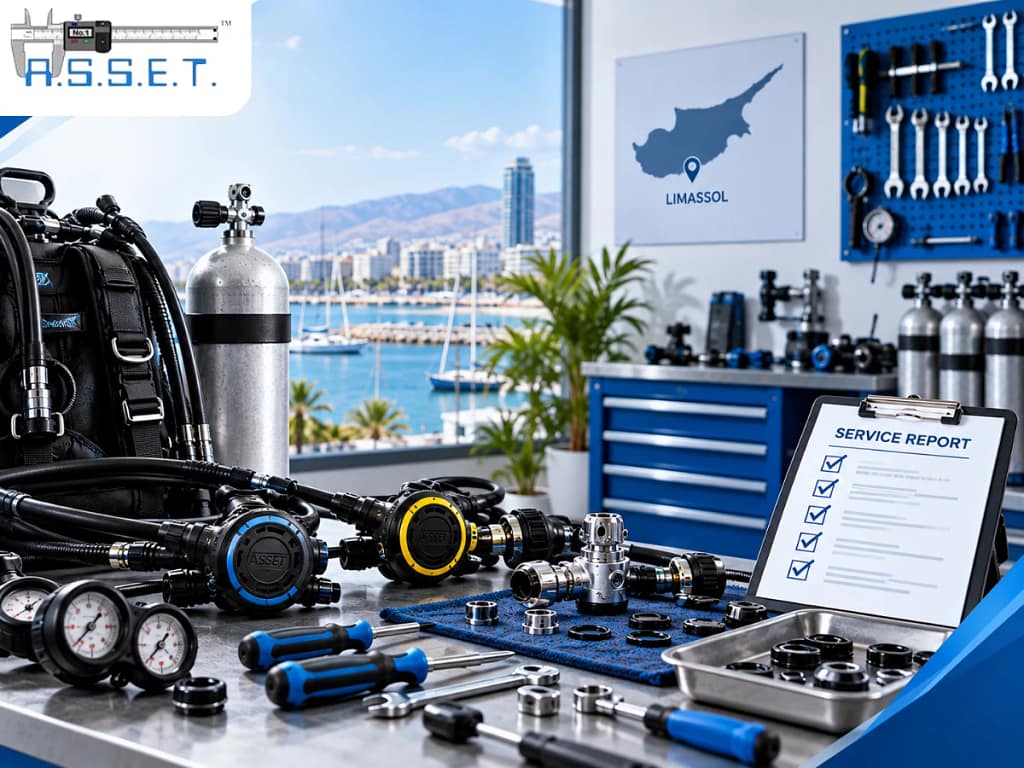
Case Study: A Limassol Dive Center Builds In-House Servicing
Years of shipping regulators to a distant service center had cost one Limassol dive center real rental days, especially during peak summer. Rather than keep outsourcing, the owner sent a staff member for full certification instead.
The DITC changed things fast. That technician started servicing the fleet in-house, downtime dropped, and the shipping delays that used to eat into the busy season disappeared. A year later, the center was servicing equipment for nearby operators too, certification had quietly become a genuine second revenue stream.
Frequently Asked Questions
How do I become a certified scuba equipment technician?
Complete a recognized course, such as the Dive Industry Technician Course, covering theory, hands-on practical work, and a final assessment. Most programs expect at least a basic diving certification beforehand.
What is the difference between ASSET and IDEST certification?
ASSET focuses on technician training, competence certification, and codes of practice for equipment maintenance. IDEST focuses on inspecting and quality-assuring the servicing and testing facilities themselves. Many technicians hold certification recognized by both.
How much does scuba equipment service certification cost?
Cost varies by course length and level; single-focus courses like cylinder inspection cost less than comprehensive multi-day programs like the DITC. Contact a training provider directly for current course fees.
Can I service scuba equipment without certification?
Servicing life support diving equipment without formal certification is not recommended and is generally not accepted by manufacturers, insurers, or dive centers, since it carries real safety risk and typically voids equipment warranties.
How long does it take to become a certified scuba technician?
Single-focus certifications can take one to two days. A comprehensive qualification like the DITC typically runs around ten days, combining theory and hands-on training.
Is scuba technician certification worth it for a small dive center?
Yes, particularly if the center currently outsources servicing. In-house certification reduces equipment downtime and shipping delays, and can also open up servicing work for nearby operators.
Start Your Certification Journey
Whether you’re reducing equipment downtime at your own center or building a career in Cyprus’s dive industry, proper certification is the foundation. Explore our course offerings at Dive Technician to find your starting point.