Scuba Cylinder Visual Inspection Course: What It Teaches and Why Every Diver in Cyprus Should Care
Most divers don’t really think twice about the cylinder on their back. It just becomes part of the routine: gear up, go diving, come back, rinse everything, and store it away.
The problem: What you can’t see is often what matters most. Moisture and corrosion can slowly start to build up inside that tank. Small issues around the neck or valve can develop over time. Everything may look fine on the outside. But the real condition of the cylinder is something you can’t judge just by a quick look.
They just wait. A Scuba Cylinder Visual Inspection Course exists because “it looks okay to me” is not an inspection standard, and in Cyprus, where dive centres operate year-round under increasing regulatory scrutiny, that distinction now carries real legal weight.
Whether you run a dive centre in Ayia Napa, work as a technician in Limassol, or manage a fleet of rental cylinders in Protaras, here is exactly what this course covers, who needs it, and what Cyprus regulations now require.
Cylinder Safety Is Now a Legal Matter in Cyprus
Cyprus has been tightening its grip on dive industry standards. Under the updated diving regulations, all service providers must now follow CYS EN ISO 24803, which sets the official standard for recreational diving operations in Cyprus.
This applies to everyone involved in the industry: From dive centres and scuba training schools to independent instructors and boat operators.
In simple terms, it means every part of the diving service must meet the same recognized safety and quality requirements, no matter who is providing it.
The Cyprus Federation of Underwater Activities (CFUA) oversees sport diving under the Cyprus Sports Organisation, while commercial dive operators fall under the Deputy Ministry of Tourism licensing framework. Without proper certification and documented equipment inspection procedures, a dive centre cannot legally operate or fill cylinders on site.
This is not bureaucratic noise. It is the reason a Scuba Cylinder Visual Inspection Course is no longer just a professional development option for Cyprus dive professionals. It is becoming part of basic compliance.
What the Scuba Cylinder Visual Inspection Course Actually Covers
A proper scuba tank inspection certification is not a lecture and a quiz. It is hands-on, methodical and built around the international standard that governs cylinder inspection across Europe and beyond.
At Dive Technician, the course is structured around ISO 18119 / EN 18119, the European framework for periodic inspection and testing of seamless steel and aluminium cylinders. Here is what that looks like in practice:
Cylinder construction and materials: You learn the difference between steel and aluminium alloys, including why certain aluminium grades such as 6351 carry a higher risk of Sustained Load Cracking. Understanding what a cylinder is made of tells you how and where it is most likely to fail.
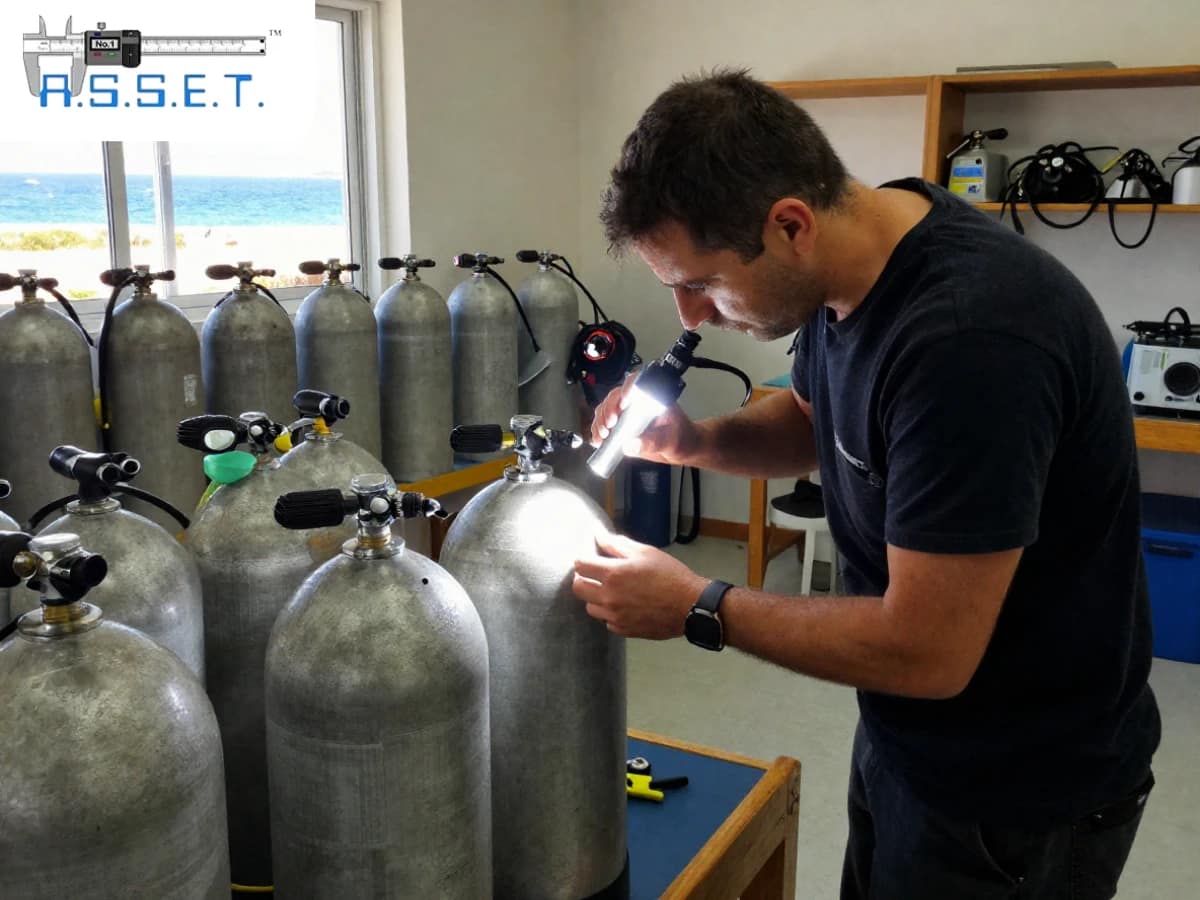
Full visual inspection procedures: Participants learn to examine the neck, threads, shoulder, body and base using proper lighting and borescope equipment. You learn the difference between acceptable surface marks and defects that condemn a cylinder outright. This is the skill that separates a trained inspector from someone who had a look.
Scuba valve inspection and servicing awareness: The valve is the most frequently missed component in cylinder safety checks. The course covers worn O-rings, damaged valve seats, corroded stems and burst disc condition. A compromised valve on a high-pressure cylinder is a hazard that shows no warning before it becomes a serious incident.
Contamination and moisture detection: Even a small amount of water trapped inside a steel cylinder can create localised corrosion that appears minor at the neck but has already weakened the metal wall beneath. You learn to identify this, record it correctly and take the right action.
Documentation, rejection and record-keeping: ISO 18119 requires full traceability. Participants learn how to maintain inspection records, apply stickers correctly, condemn cylinders that fail criteria and communicate findings clearly to cylinder owners. This documentation is not optional. It is what protects you and your business if anything is ever questioned.
Who Needs This Course in Cyprus
Dive centre technicians and equipment managers are the most straightforward case. Under Cyprus ISO 24803 compliance requirements, equipment inspection must be carried out by qualified individuals. If your centre fills cylinders, someone on your team needs this certification.
Dive instructors and divemasters handling rental fleet cylinders that rotate through dozens of different divers each season are in constant contact with equipment that takes heavy use. Knowing when a cylinder has reached the limit of safe service life is part of professional responsibility, not an optional extra.
Technical divers running backmount doubles, sidemount configurations or stage cylinders for deep or cave diving need to know the condition of every pressure vessel they enter the water with. A twin-set failure during a decompression stop is not a recoverable situation without very specific training and luck.
Rebreather divers using oxygen-service cylinders face a higher standard still. Contamination inside a cylinder in oxygen service is a fire and explosion risk. The inspection criteria are stricter and the consequences of getting it wrong are more severe.
What Trained Inspectors Find That Nobody Else Does
The Divers Alert Network (DAN) notes that annual visual inspection is considered best practice precisely because diving exposes cylinders to a uniquely corrosive environment with frequent handling. The defects that trained inspectors catch most often are the ones that look like nothing to an untrained eye.
The most commonly missed problems include:
- Sustained Load Cracking (SLC) in aluminium cylinders, hairline fractures forming around the neck and shoulder that are invisible without knowing the specific visual signature to look for
- Internal pitting and line corrosion in steel cylinders that appears manageable at the neck opening but has spread along the body wall
- Valve seat erosion creating continuous slow leakage under pressure that is never noticed until a fill station refuses the cylinder
- Base and boot corrosion where rubber protectors trap moisture against steel, corroding the base entirely out of view between inspections
None of these looks like an emergency in the early stages. All of them become one eventually.
The Standard Behind the Course
The inspection framework used at Dive Technician is built on ISO 18119 / EN 18119, the internationally recognised standard for periodic inspection and testing of high-pressure seamless cylinders. This is the same framework referenced by cylinder manufacturers across Europe and accepted by fill stations operating to professional standards throughout Cyprus and the Mediterranean region.
For context, DAN’s guidance on cylinder inspection makes clear that visual inspection is required annually regardless of hydrostatic test schedules, and that the two processes serve completely different safety functions. Completing one does not replace the other.
When choosing a course, confirm three things:
- The certification is recognised by your local fill station and any operating partners
- The course includes practical hands-on assessment with real cylinders, not theory alone
- Your instructor holds a current, valid inspector credential themselves
After the Course, Everything Looks Different
Graduates do not just walk away with a certificate. They walk away seeing cylinders differently.
You start noticing neck markings, hydro dates, boot condition, and valve torque. You start catching things that experienced divers walk past every day. For a dive centre, having a qualified inspector on staff is the difference between guessing and knowing when a cylinder is safe to fill. For a technical diver, it shifts the standard from “this looks fine” to “this is fine.”
Cyprus dive operations running under the new ISO 24803 licensing framework need this level of documented, verified competence. The days of informal checks and visual guesswork are being phased out, and rightly so.
FAQs
1. How much does a scuba tank visual inspection cost in Cyprus?
In Cyprus, a scuba tank visual inspection usually costs around €10 to €25.
The exact price depends on the dive center and cylinder size.
2. What skills are needed for visual inspection?
A person doing an inspection should know:
- Basic structure of scuba cylinders
- How to spot rust, dents, and cracks
- Safe handling of compressed gas tanks
- Use of inspection tools like a bright light and a mirror
- Proper training from a certified diving authority
3. How to inspect a diving cylinder?
The inspection is done step by step:
- Make sure the tank is fully empty
- Remove the valve carefully
- Check inside using a strong light
- Look for rust, moisture, or damage
- Check outside for dents, scratches, or corrosion
- Clean if needed
- Approve only if everything looks safe
4. Do scuba cylinders require pressure testing and visual inspection?
Yes, both are required in Cyprus and most countries:
- Visual Inspection (VIP): usually every 1 year
- Hydrostatic Pressure Test: usually every 3 to 5 years
Both tests ensure the cylinder is safe for diving.
5. What are the limitations of visual inspection?
Visual inspection has limits:
- It cannot fully measure tank strength
- It may not detect deep internal metal fatigue
- It cannot guarantee safety under high pressure
That’s why hydro testing is also necessary for full safety.
One Question Before Your Next Cylinder Fill
When did someone who is actually qualified last inspect the inside of your cylinders?
If the answer is vague, that is worth acting on. A Scuba Cylinder Visual Inspection Course takes one day. The protection it gives your team, your customers, and your operation lasts far longer than that.
Find out about the next available course at dive-technician.com and get your team qualified to the standard Cyprus dive operations now require.